CSS (Context Sensitive Solutions)
The Project
CSS Process Overview
WHAT WAS CONTEXT SENSITIVE SOLUTIONS (CSS)?
Context Sensitive Solutions (CSS) was a collaborative, interdisciplinary approach that involved the community and all key stakeholders in the planning and design of a transportation facility that fulfilled its purpose while complementing and enhancing the context in which it was situated. It was an approach that led to preserving and enhancing scenic, aesthetic, cultural, historic, community, and environmental resources while maintaining or improving mobility, capacity, and safety. The CSS process involved all stakeholders, including community members, interest groups, elected officials, and affected local, state, and federal agencies. It placed project needs and both agency and community values on a level playing field and considered all trade-offs in the decision-making and project development process.
Defatult Closed
HOW DID CSS BENEFIT THE I-49 LAFAYETTE CONNECTOR?
The I-49 Lafayette Connector CSS process was originally designed to ensure that the 21 commitments identified in the 2003 Final Environmental Impact Statement (FEIS) Record of Decision (ROD) were fully addressed. These commitments identified key project-related features for which minimization and mitigation measures, as well as potential enhancements, were required to address adverse impacts and support implementation of the Selected Alternative, commonly referred to as the 2003 ROD Alternative.
Furthermore, the Summary of Decision included in the ROD indicated that the LCG Corridor Preservation and Management Action Plan would serve as the guiding document for integrating the design and construction of the I-49 Lafayette Connector. This document also supported a CSS-based approach intended to achieve the overarching stakeholder goals of enhancing community connectedness and creating a signature place, rather than simply a signature structure, through comprehensive project planning, design, and implementation.
WHY WAS THE CONCEPT REFINEMENT PROCESS CONDUCTED?
The CSS process was initiated in September 2015 with the intent of focusing community outreach, discussion, and debate primarily on the CSS design features of the 2003 ROD Alternative. However, it soon became apparent that the community desired a more in-depth discussion and evaluation of potential refinements to that alternative. Twelve years had passed since the ROD and nearly as many since the suspension of the previous planning and design process, and the community had undergone significant change.
In response to these community concerns, the DOTD/LCP Team conducted a Concept Refinement Process (CRP) in place of the CSS program to gather input from the community and project committees and complete what became the Alternatives Analysis for the Supplemental Environmental Impact Statement (SEIS). The process included:
- Reviewing and discussing the changes that had taken place in the community;
- Identifying potential refinements to the 2003 ROD Alternative; and
- Reviewing those potential refinements from both community and technical perspectives through a three-tiered evaluation process, which ultimately led to a recommendation from the Executive Committee (EC) for environmental evaluation in the SEIS.
In accordance with the long-standing determination of the Path to Progress Report, all Refinement Concept ideas considered during the CRP were located along the Evangeline Thruway corridor. The CSS process evolved into the Alternatives Analysis for the SEIS to reflect the community’s desire to explore modifications to the 2003 ROD Alternative (e.g., elimination of Downtown interchanges and replacement with more neighborhood- and Downtown-friendly corridor connectivity; realignment of the MLK Drive/Castille Avenue connection; simplification of the Kaliste Saloom and University/Surry interchanges to minimize airport impacts; modifications to the height and design of the mainline viaduct through the central area; enhanced cross-corridor connectivity; and multimodal accommodations).
These efforts resulted in the identification of Refinement Alternatives C-5 and C-6, which were established to study corridor modifications while fulfilling the project’s overarching mobility and community connectivity goals.
WHAT WERE THE CSS PROGRAM OBJECTIVES?
The I-49 Lafayette Connector CSS Program strived to:
- Reach a common vision for the I-49 Lafayette Connector with the community and key stakeholders through a collaborative process that addressed three levels of community context:
- Study Area Level I (I-49 Lafayette Connector right-of-way): Transportation facilities and related features within the right-of-way.
- Study Area Level II (immediate 500-foot influence area on either side of the corridor): Enhancement of community cohesion and neighborhood connectivity on both sides of the right-of-way.
- Study Area Level III (immediately impacted adjacent neighborhoods): Assurance that Level I and II elements complemented the revitalization program for immediately adjacent neighborhoods being addressed through the Evangeline Corridor Initiative.
- Prepare the CSS Design Standards Manual for the final design and construction of the I-49 Lafayette Connector to provide regional mobility, excellent community access, and a variety of features that complemented Downtown and the adjacent neighborhoods.
- Structure the CSS process to facilitate informed project implementation phasing and support rapid progression into final design and project construction.
HOW WERE CSS DECISIONS MADE?
The I-49 Lafayette Connector CSS Program was carried out through a two-tiered advisory group and committee structure. The DOTD established the new Lafayette Connector Advisory Group (LCAG), replacing the Community Work Group (CWG) and Technical Advisory Committee (TAC) that had been utilized during the Concept Refinement Process (CRP), and continued to utilize the Executive Committee (EC), which was composed of the directors and senior staff of the Project Partner Agencies (FHWA, DOTD, MPO, and LCG).
The LCAG and EC met regularly and at key project milestones to discuss and provide input and direction on design elements for the I-49 Lafayette Connector project. The design decisions made through this process were compiled into the CSS Design Standards Manual for the project. The specific roles of the two committees were as follows:
- Lafayette Connector Advisory Group (LCAG): Provided combined community and technical input and recommendations on the various design feature areas and elements identified through the CSS Design Workshops.
- Executive Committee (EC): Reviewed recommendations from the LCAG, neighborhood outreach efforts, and public workshops, and made recommendations to the DOTD and FHWA regarding the Preferred Alternative, mitigation measures, potential design enhancements, and proposed joint-use development projects identified through the CSS process.
In addition to the two-tiered advisory group and committee structure, neighborhood meetings were held at key milestones with each existing neighborhood coterie and other organizations along the corridor. Partner Agency Meetings were held concurrently with CSS Design Workshops to provide input on mitigation measures, potential design enhancements, and proposed joint-use development projects. Public Workshops were also conducted at key milestones throughout the CSS process to provide input to the Executive Committee.
- Lafayette Connector Advisory Group:
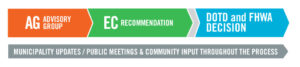
To provide combined community and technical input and recommendations on the various design feature areas and elements listed below under CSS Design Workshops. - Executive Committee:
To review all recommendations from the LCAG, neighborhood outreach and public workshops and to make a recommendation to the DOTD and FHWA on the Preferred Alternative and the various mitigation measures, potential design enhancements and proposed joint use development projects identified through the CSS process.
In addition to the two-tiered advisory group/committee structure, neighborhood meetings will be held at key milestones with each existing neighborhood coterie and other organizations along the corridor; Partner Agency Meetings will be held concurrent with CSS Design Workshops to provide input on mitigation measures, potential design enhancements and proposed joint use development projects; and Public Workshops will be conducted at key milestones in the CSS Process to provide input to the Executive Committee.
WHAT WERE THE CSS DESIGN WORKSHOPS?
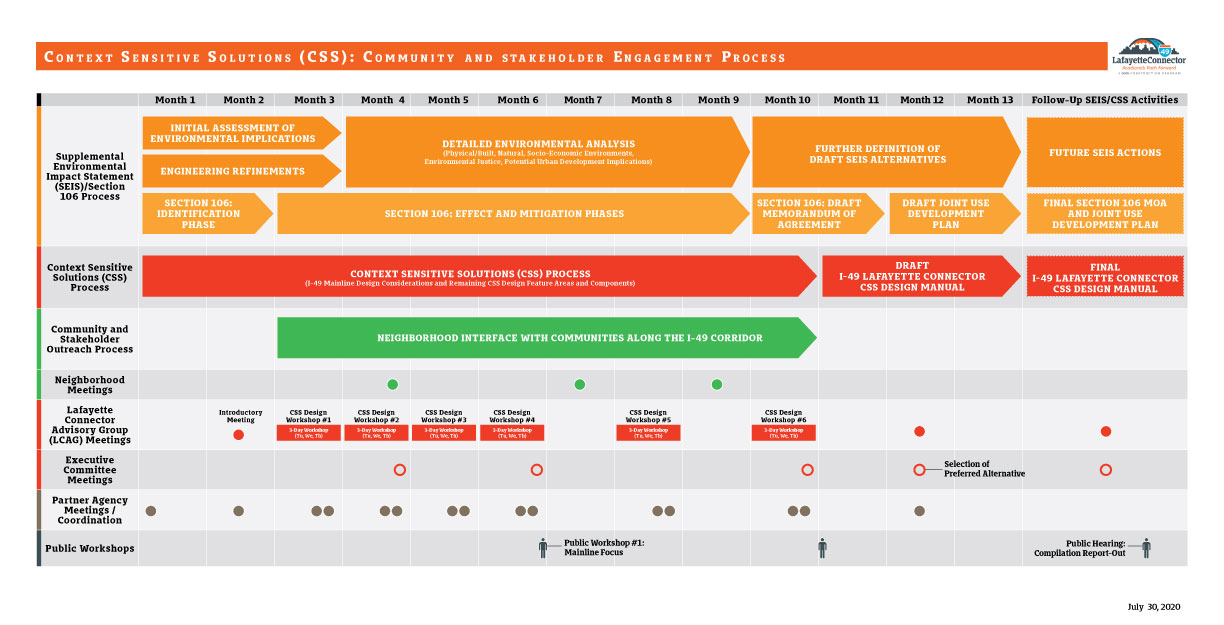
The work of the LCAG was largely centered around the conduct of six week-long workshops held during the first ten months of the CSS process. Each workshop was intended to examine, discuss, evaluate, and prioritize design feature areas and elements that would comprise the I-49 Lafayette Connector. The schedule of these workshops was illustrated in the CSS: Community and Stakeholder Engagement Process diagram and included:
CSS Design Workshop #1: Core Area Mainline Structural Components
- Viaduct profiles and heights
- Bridge bent columns, girders, and pier types
- Parapet, abutment, and retaining wall options
CSS Design Workshop #2: Core Area Mainline Structural Components
- Signature Bridge
- Entryway features
CSS Design Workshop #3: Evangeline Thruway Corridor
- Grand Boulevard and Couplet options
- Core area streets and connectivity
- Bicycle and pedestrian features
- Urban design features
- Landscape architectural features
CSS Design Workshop #4: Potential Gateways, Under Structure, and Adjacent Uses
- North and South Gateways
- Willow, University/Surry, and Kaliste Saloom interchange treatments
- Beaver Park access
- Joint-use opportunity options
CSS Design Workshop #5: Corridor-Wide Features
- Lighting types and options
- Corridor-wide bicycle and pedestrian features
- Community art, culture, and historic reference integration
CSS Design Workshop #6: Corridor-Wide Features
- Corridor-wide site furnishing and street furniture features
- Corridor-wide landscape architectural features
WHAT IS THE CSS DESIGN STANDARDS MANUAL?
The CSS Design Standards Manual documented the Connector design feature areas and elements that were discussed, reviewed, analyzed, prioritized, and accepted as project components by the DOTD and FHWA based on the Executive Committee (EC) recommendation of the Preferred Alternative. These recommendations were the products of the 13-month CSS process, which included community involvement, stakeholder outreach, agency coordination, and the Advisory Group/Committee work process.
The intent of the CSS Design Standards Manual is to inform the final design of the I-49 Lafayette Connector project and related improvements with regard to corridor aesthetic consistency, community integration, and compliance with stakeholder and community input. The initial design feature areas and elements of the I-49 Lafayette Connector were first defined by the community, staff, and public officials during the initial CSS process that had not been completed for the 2003 ROD Alternative. These elements were revised and refined through this CSS process.
These elements serve as key form-giving project components that fulfill the project’s mobility objectives and have the ability to make the project a “signature place” of significant benefit to its surroundings; establish community connections between the neighborhoods and various districts along the corridor; and provide a sense of community integration and cohesion through thoughtful references to the region’s history and culture.
